
IDX Logo Transparent Background
Growth Automation

Solana Volume Bot Learn More

Choose the right bot landing, match an engine to your launch stage, fund on-chain automation, and monitor results β€” with clear notes on liquidity, cashback, and DexScreener visibility.

IDX volume bot illustration

Launchlab creator? Launch first, then boost.

Fair-launch on IDX Launchlab’s bonding curve, earn creator fees on every trade, then run a volume bot to accelerate chart activity. Claim earnings anytime from Rewards.

Open IDX Launchlab create flow

Track bots from your dashboard

Start, stop, recharge, and refund gas from one place. Monitor engine status and bot health while automation runs on-chain across supported Solana DEX pools β€” so DexScreener activity reflects real swaps, not a browser tab you have to babysit.
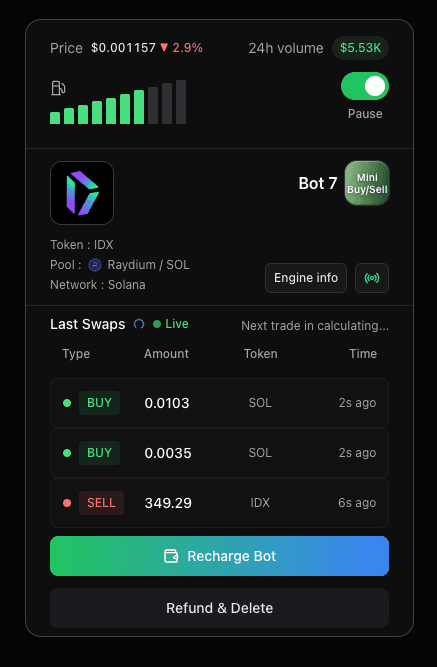
IDX AutoBot dashboard preview β€” Mini Buy/Sell bot card with gas level, last swaps, and controls

Watch How It Works

See IDX AutoBot in action

Who should use this tool

  • - Token founders launching on Solana
  • - IDX Launchlab creators boosting curve activity
  • - Growth teams sustaining volume after pool graduation

Primary use case

IDX volume bots automate on-chain swaps across supported Solana pools so teams can add chart activity during launch windows β€” after liquidity exists and the right bot landing is chosen.

When volume bots fit a Solana launch

IDX volume bots suit launch windows, relaunch visibility pushes, and post-graduation chart activity when you already have baseline liquidity and a clear narrative. Fair-launch on IDX Launchlab first if you want creator fees, then boost from the IDX bot landing so swaps accrue claimable rewards. Avoid heavy spend on weak pools, running bots before a public landing page is ready, or treating automation as a guaranteed trending or fill machine.

Campaign hygiene and expectations

Set budget expectations upfront, run a short validation window, assign someone to monitor the dashboard daily, and communicate transparently with your community. Pair engine choice to stage β€” V4/V6 for tests, V8/V12/Mini layers for aggressive windows β€” and stop bots with unused-gas refunds when the campaign ends.

Which engine should you pick?

Engines differ in trade frequency, maker count, and SOL spend. Match activity to your lifecycle β€” you can run up to three engines on one launch. V12 and V8 push hard; V6/V4/V4 Eco suit steadier budgets; Mini Buy and Mini Buy/Sell add dense micro-swap layers beside a primary engine.

V12 and V8 β€” aggressive visibility

V12 is the top ranking push (~4 SOL/hr, instant trades, very high maker count; often paired with Mini Buy/Sell). V8 is high activity (~0.5 SOL/hr, 2400+ SOL/day, 4000+ makers/day, trades every 15–30 sec) for launch windows and post-graduation chart pressure without full V12 spend.

V6, V4, and V4 Eco β€” sustained budgets

V6 keeps mid-tier cadence (~0.15 SOL/hr). V4 is the light organic boost (~0.045 SOL/hr, ~6–9 min); V4 Eco runs ~7–10 min at a lower hourly burn (~0.032 SOL/hr). Use these when testing spend or supporting thin liquidity.

Mini Buy and Mini Buy/Sell

Mini Buy stacks bid-side micro purchases; Mini Buy/Sell alternates two-sided micro swaps (~30/min). Layer either with V12 or V8 when you want denser chart texture on top of a primary engine.

How it works

1) Step

Pick the landing that fits your token β€” general hub, DEX-specific page, or IDX Launchlab bot.

2) Step

Connect wallet, paste mint address, and confirm token symbol.

3) Step

Select up to three engines (V12, V4, V4 Eco, V6, V8, Mini Buy, Mini Buy/Sell) for your budget and stage.

4) Step

Recharge in SOL, start from dashboard, monitor trades, and stop or refund unused gas anytime.

Decision checklist

  • - Token mint is verified and trades on a supported pool or Launchlab route.
  • - Correct bot landing is selected (general, DEX-specific, or IDX Launchlab).
  • - Engine choice matches budget and launch stage (V4/V6 vs V8/V12/Mini).
  • - Landing page, socials, and narrative are ready before visibility spikes.
  • - Dashboard owner assigned to monitor spend and bot health daily.

Risk and trust notes

  • - Volume automation does not guarantee price action, bonding curve completion, or exchange listings.
  • - Set recharge limits you are comfortable losing to gas and slippage before scaling spend.
  • - Verify mint address and pool support before funding β€” wrong mint or unsupported routes waste SOL.
  • - Stop bots and refund unused gas from the dashboard when pausing a campaign.

FAQ

Which Solana pools and landings does IDX support?

Bots work with Pump.fun, Raydium, Orca, Meteora, IDX Launchlab, Moonit, FluxBags, Bags, and related routes. Use a DEX-specific landing when your token mainly trades on one venue; use the general hub for multi-DEX tokens; use the IDX Launchlab bot when you launched there and want creator-fee context.

Does a volume bot guarantee DexScreener trending?

No. Bots increase on-chain trading activity and transaction count. Rankings still depend on broader market demand. Your token should already trade on a supported pool β€” create or graduate liquidity first, then fund the bot.

How do Launchlab fees and multi-engine runs work?

IDX Launchlab creators earn fixed creator fees on trades (0.5% on the curve, then pool fees via Fee Key NFT after graduation). Pump.fun uses market-cap-tier bot fee rebates. You can run up to three engines on one launch with the same mint β€” IDX creates one bot per engine.

What should I monitor during a campaign?

Track SOL spend pace, bot status, transaction health, and market response. Pause and refund unused gas from the dashboard if activity or ROI is off target.